Natural Dog Training Explained
The dog training world can be quite confusing to dog owners, there seem to be more and more buzz words each year, new methods that guarantee results. Social media I feel makes it harder and harder for people to know what is the best way to train your dog, you see a 30 second video of outstanding heeling in a busy environment, or a dog appearing vicious and aggressive being transformed into a calm approachable dog and you want that for your dog. There are companies that offer hiking trips, beach trips, day cares for your dog. But none of this addresses a key element of dog training , rapport between the dog and the human. The relationship is everything.
Its why Taipei Dog Training doesn’t offer board and train packages, I know I can train your dog all manner of obedience. But the magic of training, at least the way we do it is in the teamwork you develop while training. I can train your dog and return it to you, but the rapport is between me and your dog. Not you and your dog. And without that the obedience slips over time.
The Real Reason Dogs Develop Problem Behaviours
There has been a lot of debate over the years as to whether or not dogs are a pack animal, is there an alpha or not. To me it’s redundant really, it’s universally accepted that dogs are social animals, theres no debate there. When they live in our homes then we are in charge, that’s not an ego statement, it’s common sense. Natural dog training uses the dogs innate desire to be in a group to be content, to feel safe, to be able to relax. The reward isn’t a treat, the reward is being part of the team. Separation anxiety is a great example of a dog not feeling part of a team, or fearing they are being left in some way. The dynamic you have with your dog dictates how they feel, it’s why I believe owners have the same issues with different dogs in their lives. Ive seen it over and over, people have a dog aggressive dog and it passes and they get another dog, it too develops dog aggression. The problem may be aggression, separation anxiety, timidity etc but when these happen it’s usually a relationship issue, but when it happens repeatedly it’s definitely a relationship issue, the dynamic is wrong. This may feel a bit like a slap in the face especially if you are struggling with a behaviour problem, but its actually good news, you can change the dynamic, you can decide to do that.
Building Rapport Using the Natural Dog Training Method
The Natural Dog Training method was created by Kevin Behan. We haven’t trained directly under him and we don’t follow his method rigidly, but long before we discovered his work we already believed that rapport was the foundation of everything. His method whether you incorporate all of it or select parts of it will benefit you and your dog. Lots of other trainers use the term Natural Dog Training, but the only methodology we refer to is Kevin Behans.
The Core Exercises
- Pushing , the dog pushes into the handler to take food from their hand, at the same time the handler pushes the dog away with their other hand. The act of pushing the dog away triggers a reflex reaction to push back and drive towards the handler, when the dog does this he also gets the food reward. But the true reward is the physical interaction with the handler. As this interaction is physically vigorous ( it can and should aim to have the dog pushing the handler backwards continually ) and around food, it mimics a natural way dogs eat in a group.
- Collection, this is the opposite of pushing. A wild canine whilst needing the desire and drive to push and overcome when hunting, must also show patience, they must have impulse control. In a hunt type situation you can imagine a dog in a down position focussed on a target, but not yet in a position to make a move. Almost like a coiled spring. It’s often taught on a raised bed and the dog either sits back on its haunches or lays down with his back legs under him. Using food or a toy the dog is encouraged to push back on his haunches and rewarded when he does, this teaches him to be in a ready state similar to a hunt.The toys or treats are then moved around like prey, the dog tracks the moving item with his head and eyes but keeps the tension loaded in his back legs — the urge to go forward is there, but he’s learning to hold it.
- Barking ( speak ), this is simply teaching the dog to bark for a reward or in response to a command. It seems quite a minor exercise but dogs do vocalise and living in silence isn’t natural. If there is no outlet to vocalise we may get a dog that barks at inappropriate times, barking is often described as a self rewarding behaviour, that just means they enjoy it. Far better to be able to have some control over barking, whilst also giving the dog the opportunity. You can also use the behaviour for useful communication, where the dog goes to the door and barks when they need the toilet.
- Rub-a-dub, this is a gentle slow massage of the dogs neck, shoulders and back. It is designed to slow the dogs mental state down . The first 3 exercises have all been building up the dogs excitement, so the counter balance to that is the relaxing exercise. We don’t want to leave a dog in an excited state we want them to be able to settle and relax, so much of training is building up excitement to get a reward ( which is also exciting ) being able to teach our dog to relax is very overlooked, but so essential to a peaceful coexistence with a dog in your home.
- Bite/Tug/Carry, this is the age old game a young boy and his dog play. You get a toy and on cue the dog bites it, you play tug of war with the dog, then let him have the toy and carry it for a while. It is great fun for a kid to play with their dog like this, but from the dogs perspective its carrying out a natural cycle that would occur in the hunt.They bite and wrestle with the prey and carry it when successful. That is a rewarding and satisfying feeling for the dog. And they did it with you.
These exercises help because they are naturally or instinctively fun or satisfying to your dog. They satisfy desires inherent in dogs, and they do these things with you as a team. Its not a hierarchal relationship – its a social relationship, built from the dogs perspective as a hunter. They don’t replace the obedience lessons a dog usually needs , loose leash walking, recall, and go to bed etc. There is a cross over though, pushing can be used as part of recall training, collection has some parallels to the place command for example. But the real strength is these exercises make your dog want to work with you, they make them engaged with you, you have your dogs interest and attention. That makes training specific tasks much easier. This approach is ‘what you can do for your dog’ as opposed to ‘what you want your dog to do for you’, its a fairer more balanced approach that makes both ends of the leash happy.
Taipei Dog Trainings Twist to the System
When I first came across Kevin Behan and his system, the first thing that jumped out at me was whilst totally new to me, it was also similar to my approach with many clients dogs. As the years have gone by my focus has moved heavily from gettng the dogs to do x y or z behaviour and much more to how we can satisfy our dogs and as a result watch behaviour issues melt away. The issues are symptoms.
With my own dog Rosie she was attacked and bitten badly near our home by an off leash dog. She became very reactive, threatening towards other dogs. To an observer she would look fierce and aggressive. The truth was she didn’t want the dog to approach in case it attacked her, she had lost her trust in other dogs. This made her walks stressful for her and me, she left the house and was on high alert instantly.
The fix was fairly straight forward, Rose loves high tempo exercises – spinning, left heel, round my back to right heel, round the front and finish between my legs, sit as I walk a few steps back and then rush to heel again, walk together in a focused heel and spin. These aren’t natural behaviours being satisfied in Rose, but she enjoys doing them, with me. So what we did we started doing these exercises when we knew there would be people walking their dogs. She was then torn between reacting to a dog and doing what she loved doing. She knew dogs were nearby, but she was having fun with me. So she stayed engaged with me, and at the same time nothing bad happened with the dogs, she learned to relax in their presence again.
If you have a dog that is afraid of thunder you can try something similar, if you know a storm is coming be ready. Do something they love to do with you, you need to be excited yourself, your excitement and happiness is the counter to the fear of the thunder.
Breed Specific Play
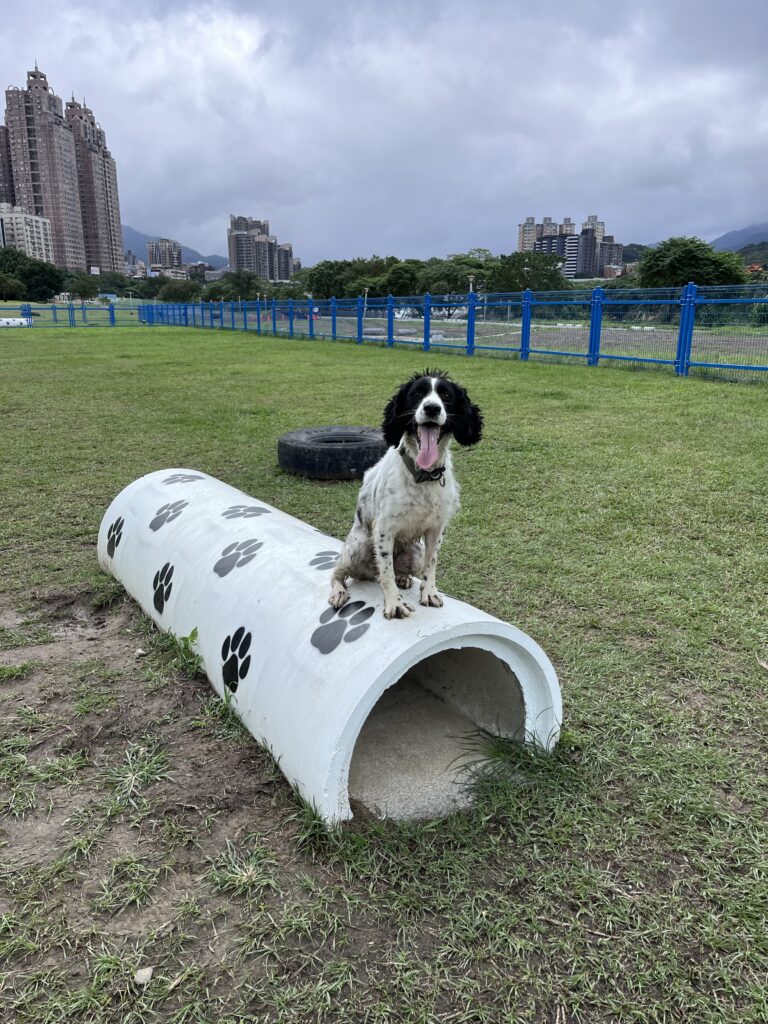
The Natural Dog Training method is applicable to all dogs. But you will also find that different breeds have had behaviours bred strongly into them. Back to Rosie she’s a Springer Spaniel, she’s been bred to locate birds, flush them out ( spring them ) so a hunter can shoot them and she would then carry the bird back to the hunter. She has her own breed specific bite/tug/carry which is actually find/catch/retrieve. Now I could walk her in the fields near my home but she would constantly want to enter the bushes ( find ) , that’s not very safe in Taiwan as we have many venomous snakes. So to satisfy the instincts bred into her over generations we play frisbee, we start the sequence by making her run through my legs, I throw the frisbee and usually she catches it on the way down ( catch ) and she brings it back to me so we can throw it again ( retrieve ). There is no reward for any of this, the reward is doing it again. She brings it to me and I will celebrate with her and through my legs she goes, and I throw again. She has no intention to wander off, the thought doesn’t cross her mind, she’s playing with me, we are doing what she is bred to do. This is satisfying to her. So when you are thinking of what to play with your dog, have a think about what they were bred for, and see if you can make a game that satisfies that desire.
The Recall
I think one of the best things you can do for your dog is be able to let them off the leash to run and play. It’s also one of the things many dog owners are nervous about doing, what if their dog keeps running? You can’t force an off leash dog to come back, you are not going to be able to catch your dog if they don’t want you to. The best recall I have ever seen is a Spanish guy in Taipei he has 2 beautiful bull terriers, they can be doing anything , playing with dogs, playing with each other, anything. He puts two fingers in his mouth and loudly whistles, the dogs stop what they are doing and sprint back to him, they jump up he catches them spins them around throws them away and they bounce back at him again. It never fails. They don’t hear the whistle and think I must stop what I’m doing and go back to him, they hear it and think he wants to play with us, the throw away is the push it encourages them to come again. Its a far more impressive recall than you see in a competition because in a competition there are no distractions, the dog is waiting for the recall, in this case they are doing their own thing and then the whistle. It works because he has amazing rapport.
He is the source of the best fun in their world.
The push exercise is a great foundation for this, once you build rapport they will want to come to you when you call. You can’t make them come back, but you can make them want to.
If you’d like to build this kind of rapport with your dog, get in touch and tell us a little about your dog — we’d love to help.
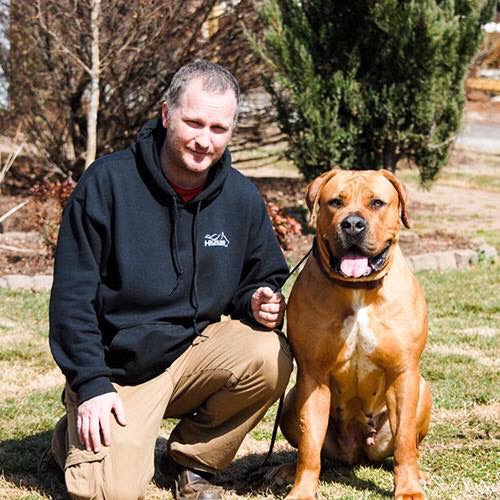
Steven has been training dogs for over 40 years, working across pet obedience, shelter rehabilitation, police K9 teams in the USA, the British Army in Bosnia, and more recently the Taipei Police K9 unit and Taiwan Coast Guard. His work has been featured by National Geographic. He runs Taipei Dog Training with a focus on building genuine rapport between dogs and their owners — because a dog that wants to work with you is worth more than a dog that has been trained to comply